
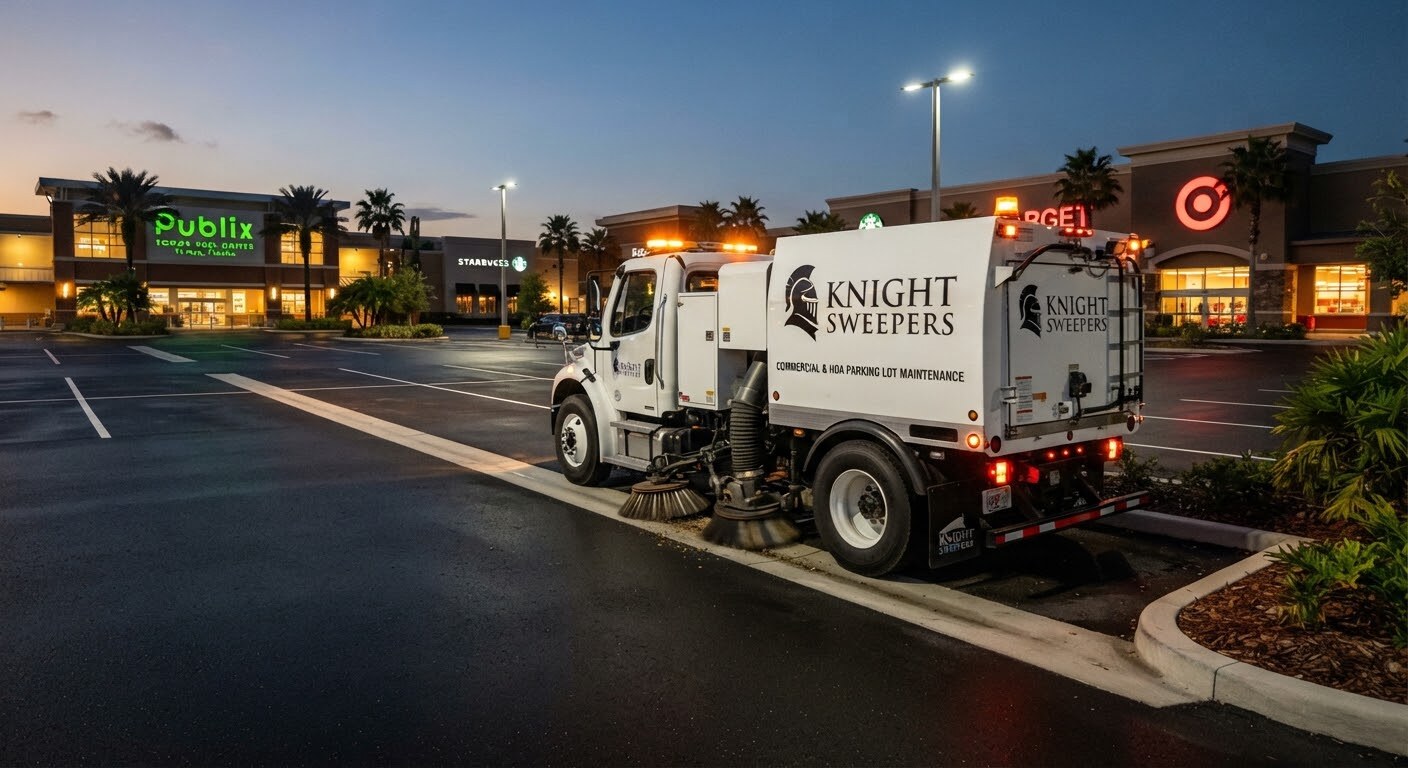
HOA boards and community managers have a different sweeping problem than a shopping center. The traffic is lighter, but residents live next to the pavement, notice every noise, and judge the association on curb appeal. Here is how to set up a street and parking sweeping program that keeps the community looking sharp without waking anyone up.
Why communities sweep
- Curb appeal and property values. Clean gutters and bright striping are the first impression for buyers and guests.
- Pavement life. Sand left on asphalt grinds into the surface under tires and shortens the interval between sealcoats and overlays, which are large reserve-fund expenses.
- Drainage. Private roads often drain to community retention ponds the HOA is responsible for maintaining. Sweeping keeps sediment and leaf litter out of them.
- Safety. Pine needles, acorns, and wet leaves are a slip hazard on sidewalks and crosswalks.
Scheduling around residents
Commercial lots are swept overnight. Communities usually prefer daytime, mid-morning to early afternoon, after the school run and before evening traffic. Our community routes use sound-attenuated regenerative-air sweepers rated under 68 dB at normal operating speed, which is quieter than a typical landscape blower. Most associations settle on one of these cadences:
- Monthly for gated single-family communities with modest tree cover.
- Twice monthly for communities with heavy oak or pine canopy, or with amenity parking that gets weekend traffic.
- Weekly for condominium and townhome communities with shared parking lots and dumpster corrals.
- Seasonal deep cleans after the spring oak-leaf drop and before hurricane season to clear catch basins.
What to ask a sweeping vendor
- What equipment do you run? Regenerative-air sweepers pick up fine sand; broom-only units push it around. Ask about noise ratings and dust control.
- How do you prove the visit happened? GPS time stamps and photos should come standard, not as an add-on.
- Who does the work? Subcontracted routes change crews constantly. Owner-operated fleets tend to know the community’s problem spots.
- What is in the scope? Confirm curb line scouring, drain grate clearing, cul-de-sac turnarounds, and whether sidewalks and amenity areas are included.
- Insurance. Request a certificate of insurance naming the association, with general liability and workers’ compensation.
- Contract terms. Month-to-month with 30 days’ notice protects the board if service slips.
Communicating with residents
A short notice in the community newsletter or portal a day ahead of each sweep, asking residents to move vehicles off the street, dramatically improves results. Share a before-and-after photo afterward; boards that show the work get fewer complaints and easier budget approvals.
Getting a quote
We measure community road and parking square footage by satellite, so there is no survey truck in the neighborhood. The estimate breaks out monthly, twice-monthly, and weekly options with everything included. See our HOA and community plans or request an estimate for your association.